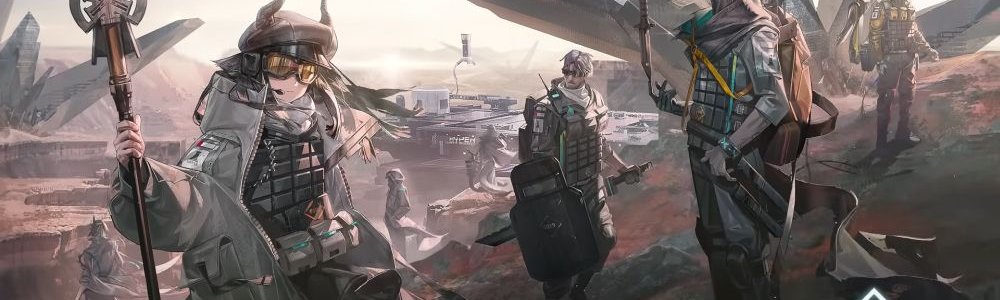
Ex Astris is a new game by Hypergryph that—unlike their previous game which I also have not shut up about, Arknights—is a normal game. It's not gacha, it's not live-service. It asks for $10 up front then lets you play the entire thing. It is released on mobile, though, which might be a bit puzzling because 1) it has a 3D environment that's easier to navigate with mouse-keyboard or a proper controller, and 2) it's probably more appealing for the console market? Like, I'm getting news that it got roasted in its home country China because mobile gamers there are just not used to paying for their games up front.
Is the game good, though? And worth the market experiment? Hahaha, oh man...
Its biggest problem is already rearing its head during the pre-release marketing. They posted these character portraits with paragraphs of lore, filled to the brim with fantasy nouns.

Known as the Princess of Doran, Vi³ has in fact no power over anyone within the laid-back realm of Doran.
Destined to be the Pilgrim of Allindo, she has heeded Laylah's call since her birth. Guided by a massive storm sparked by the Penumbra in Zin-Gerzen, she awaits the day of Reset.
What the hell is "Allido", "Laylah", "Penumbra in Zin-Gerzen", or the "day of Reset"? I thought it's a just the marketing team being a little silly. After all, these are posted on the social media pages whose followers, presumably, are already interested in the game. There are also freaks like me who grew up reading fantasy books and to whom these words signal the kind of grand worldbuilding that we might enjoy. It's a very specific niche, and not one you ought to market to, but sure, I'll allow it.
Surely, they'll introduce these concepts more smoothly in the game, right? Surely they won't just dunk people in the soup of proper nouns, hoping they pick things up along the way? The main character is, after all, someone from Earth who's travelling to a different planet. Surely, by making the main character an outsider, we'll learn things as she learn them, right? Right?
Oh, readers, it is worse that I could imagine.
The first scene you see in the game is of Yan, the main character who hails from Earth, sitting in a train. Five seconds later you are given a lore page. I hope you like reading.
Afterwards you're allowed to walk around the train, get a feel of the control. You can talk to some people in the train, though Yan doesn't seem particularly interested in talking to them. Eventually the train will crash. As you make your way out of the rubble you will meet some monsters and initiate the combat tutorial. A few solo combats later, which would probably be a bit confusing, you'll meet up with a blonde girl you might have met on the train earlier. You'll team up, get a taste the combat's combo system. Eventually you'll find your motorcycle from the rubble, and the two of you escape the monsters and on to... adventure, together? I guess?
Who is Yan? Who is the girl, who introduced herself as Vi? Where are they going? Why are they teaming up, after they managed to escape the monsters together? What happened in the train? Where did the monsters come from? Are everyone else in the train dead? Why do neither of them talk about that? The dialogues, which is minuscule, give no hints to any of this. It's all so bizarrely confusing.
Look, the beginning of any story is crucial because that's when you're telling your audience why you should care about it. It doesn't mean you can't get quickly to the action. Look at, I'm thinking of a game at random, Supergiant Games' Hades. You start off fighting from the get-go, but you learn pretty quickly that the protagonist is called Zagreus and he's son of the god Hades and he's trying to escape his father's realm. This is all from the first 30 seconds of gameplay.
You can argue that Hades has it easier because they have a Narrator who helpfully tells you the basics of the story in a folk-tale sort of way. But Ex Astris, frustratingly, is also equipped with a similar narrative device! Yan is from Earth, so she's unfamiliar with the planet she's in and is learning as she goes. She's followed around by a robot called Roy who can regurgitate factoids and be a decent conversational partner. Instead of leaning into the possibilities, Ex Astris actively decides to waste them!

Instead of inspecting her surrounding and making conversation with her robot partner, Yan is just distinctly uninterested in anything she sees. She simply reacts to things happening, but never wonders, never asks questions. She writes things down sometimes; indeed, the only mote of personality you can see from her is the mission descriptions you can read in the menu.
The mission descriptions themselves could have been an interesting narrative device but instead of supporting the story as a whole, these mission descriptions feel like they're written for a different game entirely. It speaks of things that has no connections to the scenes you just encountered. Character motives and facts about what happened magically appeared in your notes with no hints of how these information was obtained in the first place. Are these people communicating through telepathy? Is the game expecting you to be able to read mins?
The second protagonist, a cheerful girl called Vi, seems like she could be the perfect foil to Yan. While Yan is cold and distant, Vi is bright and friendly. "Chatty", I'm tempted to say, and she certainly speaks more than Yan, but Vi barely try to get you to know her. Most of the game revolves around her and her mission to, I don't even know, travel the world and "record" it before their doomsday? It was never made clear who she is and what she wants. It's only if you read the promotional materials that you'd find out she's a princess.
There are lots of moments in the game that were meant to be emotional or impactful, except, with how threadbare the storytelling has been, they never do anything to deserve that emotion. There was a man who helped you in the first chapter and it's hinted that he was sacrificing himself to do it, but you don't even get to know who the guy is or why he even has to die. There was a boss battle against a man trying to protect his daughter, but I don't even know why we're fighting the guy in the first place. Most egregious was the conflict between Vi and her brother. We never get a clear picture of what the conflict even is and when they actually confronted each other, it happened off-screen! We only get a glimpse of them talking and then they went "oh I guess talking doesn't work" followed by a boss battle.
As if mimicking Yan's cold disinterest, the game is also uninterested in telling its story. It does not care whether you care about it. Plot threads barely connect. Important characters die off-screen. In the meantime, the game asks you to go to the next mission point and the next and the next.
Ex Astris a narrative mess. Even if you want to earnestly engage with it, it doesn't give you enough to engage in. A while back I'd argue that the worldbuilding at the base of it is at least pretty good, but now that I've finished the game I'm not sure that holds either! It's a grab bag of interesting tidbits without anything coherent holding them together. It's interesting that Doran doesn't have a culture of eating meat, which might be related to how they reincarnate into each other. It's interesting that the dark side of the planet has a sentient artificial sun and that its people tame creatures made of shadows. I guess we're never gonna investigate those further than a couple lore pages huh!
Putting the narrative mess aside, the gameplay is, at least, fascinating. Combat is turn-based, but on your turn you have to time your attacks to create chains of strikes. For instance, one character's skill can lift an enemy while another character's skill can only hit airborne enemies. Each skill cost an action point, but a good combo will replenish these points. When you execute your turn skillfully, it a sublime dance. When you make a mistake, ah well, you gotta wait until the next turn.
Enemy's turn is something of a mini-rhythm game. Enemy's strikes are clearly signaled with both sight and sound, and if you hit parry at the right time you can negate most of the damage. It's more interesting than just sitting and watching your enemies beat you up, and it makes for some tense boss battles, but it does get rather dull.
As you get more characters and they learn more skills, it's pretty fun to figure out what would make a good combo. You might spend a while rearranging your skills and party members and then trying them out in battles and adjusting them afterwards. If you're not feeling up to micromanaging your combos, some characters have gimmicks that can help with that.
Unfortunately, once you've figured out a good combo, the combat loses a lot of its lustre. You're basically just doing the same thing again and again and again. Maybe sometimes you get the combo right and sometimes you get it wrong, eventually it all gets old either way. You can change up your combo if you feel bored, but with only five characters you get in total there's not that many variations to try. Battles also tend to take longer than they ought to; trying out a suboptimal combo feels like a waste when sticking to the same one will make these battles go faster.
Normal battles are usually pushovers, so there's not much incentive to play better beyond making them go faster. Boss battles, on the other hand, are rough. Bosses tend to hit like a ton of bricks, killing your character with only two or three hits. There's very little space for mistakes in the parrying game, and when you make one too many of them you gotta restart from the beginning. With their massive hit points, it also doesn't matter what sort of graceful dance you can pull off in your turn. You'll still need to survive twenty to thirty of their turns.
Still, I think the combat is worth a lot on their own. The endgame was particularly satisfying since you have your full arsenal and the enemies are evenly spaced for them. If the developers can adjust the enemy stats and placements, add a few more characters and skill variations, and streamline some of the animations (switching party members during enemy's turn is oddly heavy, for one) this can make for a very good game. At its current form though, Ex Astris's combat still leaves a lot to be desired.
Outside of combat, you'll mostly spend your time traversing intricately-modeled buildings or natural landscapes, solving puzzles or doing a little platforming along the way. The environment art is gorgeous and does a bulk of the worldbuilding: Doran is a nation of white walls and carved marbles, lined with plants and waterways, while Shadarra is all dark obsidian decorated with gargoyles resembling the shadow-creatures its people are attuned to.
The areas themselves, however, are certainly Level-Designed Levels made by Level Designers. In other games, these seemingly open areas would be described as "dungeons"; indeed, the closest thing they remind me of was the dungeons in Zelda games. This is neither a good nor a bad thing; just don't expect an open world to explore or naturalistic progression.
What is a bad thing, however, is how mindlessly straightforward these environments are. The level design is often clever: new paths open as you progress, circling back to where you started so you never feel like you're backtracking. However, with the way the camera is set and how big the set pieces are, most of the areas are hard to make a mental image of. With some rare exceptions, you'll probably just end up following the mission markers instead; markers which I suspect were only placed there after QA because a lot of people got lost! This is so obviously a band-aid to a fundamental problem that I don't think they ever solved. The end results is that, despite its intricate designs, most of Ex Astris feel like an endless string of corridors instead of a lived-in space. There is not much incentive for you to explore, much less to look out for details in the environment.
The endless corridors combined with the rote combat made the midgame a chore. Add it with the incoherent story and it was a miracle that I managed to get through all that at all. The endgame is much better, with more readable level design and more balanced enemies, but with the narrative buckling under its own incompetence, there's really not much here that's worth trudging towards. There's no great sense of accomplishment, nor was there any narrative closures. Just the knowledge that, "oh I beat Ex Astris. That really wasn't a very good game, was it."
Still, still, despite its flaws there's a lot here that could be taken for granted. The art truly is gorgeous, with strong direction and a lot of love put into it even within the visible budget constraints. The combat system, flawed as it is, really is fascinating and you won't see it anywhere else. For a $10 game that runs on your tablet (but probably not your phones if it's old because oh boy are those graphics heavy), it's worth the price of entry.
But is it worth playing, especially the whole way through? Ah. Ah well. Well. I sincerely hope HyperGryph learns the right lesson from this. (Which is to say, where are you writers, HyperGrpyh?? The ones who write for Arknights?? They are the best in the industry, why are you locking them in the basement and never let a single one of them have a look at Ex Astris because dammit any senior writer worth their salt would have seen the problem a mile away!)
I do hope this doesn't discourage HyperGrpyh from making more non-live-service games, though. They have some good elements here, they just need to tie them together in a more meaningful way.