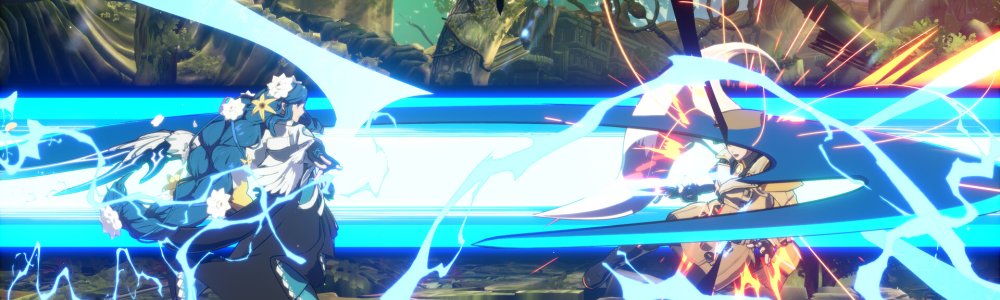
I've been listening to Granblue Fantasy Versus Rising's soundtrack a lot these past uhh *check notes* I guess it's been months at this rate. Mostly just as background music as I work, but more than a few of the tracks caught my attention every time they play. VERSUSIA is one of them, and one of the most memorable of the lot because I keep wanting to sing along to it.
I looked around for a bit and apparently Cygames have released the official lyrics and English translation over at GBVS's official twitter, but it doesn't have the romaji and aside from a lyric video that somebody made (I don't like looking at videos...) no one has ever actually written it down. I thought "sure, I can probably read and write down the romaji myself. Might be good practice".
Some of the kanji has pronunciation ruby-text on them, but not all of them. I should've taken that as a sign, haha.
So my Japanese isn't very good and I do a lot of flipping through the dictionary for this, but I really want to talk about the lyrics to this and especially how they officialy translated it! Again, I'm not fluent in Japanese, but from what I'm seeing this song use some odd grammar construction and rare pronounciations of some kanji to evoke a kind of ethereal, prayer-like lyricism to them.
The English translation didn't try to evoke the same lyricism but instead kind of pries or hints or implies to the deeper meaning between the lines. It feels almost like an annotation than a translation. Maybe Fukuhara wrote this "translation" himself?
Let me just drop the lyrics + romaji + english translation here before I go on.
VERSUSIA
Lyrics by Tetsuya Fukuhara
遠つそら
をりはへて見る
tootsu sora
orihahete miru
Far in the distance
A sky adorned in azure
青みたり運命
人知れず塩垂るる
aomitari sadane
hito shirezu shiota ruru
I gaze knowing well their burden
Alone in my silent sorrow, I weep
愛し子ら
生ひ先で待つ
itoshikora
ohi saki de matsu
Beloved children
We shall be reunited
時の獄の内
終の日を想ふ
幾十度も
ka no hitoya no uchi
tsui no hi wo omofu
ikusotabimo
I wait in time's forlorn prison
Visions of destruction blind me
They consume me again
崩るる戦いの螺旋
やがて夜は明けゆく
差し出づ戦いの世界
嗚呼 ねび行け
皆 空の命
kuzururu tatakai no rasen
yagate yo wa akeyuku
sashi idu tatakai no sekai
a! nebiyuke
mina sora no inochi
Spirals of chaos cease turning forevermore
Night yields to dawn—at last the sky clears
Light from the heavens shines upon this weary world
Follow the path it reveals
You who dwell in the sky
崩るる戦いの螺旋
嗚呼 我らはを空を見む
差し出づ戦いの世界
嗚呼 愛づらし
皆 空の命
kuzururu tatakai no rasen
a! warera wa oosora wo mimu
sashi idu tatakai no sekai
a! nedurashi
mina sora no inochi
Spirals of chaos cease turning forevermore
Upon the selfsame sky, we turn our gazes
Light from the heavens shines upon this weary world
Bask in it, be resplendant
You who dwell in the sky
空の命
sora no inochi
Beloved skydwellers...
Okay where do I start... Second verse "青みたり運命". Ao is blue, mitari is seeing, 運命 is usually pronounced unmei but here it's explicitly indicated as to be read as sadane. I looked that up, I don't think it's a word, but it is like a weird rare reading of 運命, which means fate.
Aomitari sadane, Blue-seen fate. The official translation? "I gaze knowing well their burden". Fate is a burden, "blue-seen" means seeing with her blue eyes (or perhaps, the blue of the sky?). Damn, okay.
The next line is even more awe-inspiring. "人知れず塩垂るる" Hito means person, shirezu means without knowing, and then 塩垂 stumped me. Shio? Salt? The other kanji means hanging, drooping, slouching, sauce? Ruru isn't really a word, I thought, but I looked it up, it might be 縷々, a rare word which means unending or continuous, which would play with how ru is the usual ending for verbs.
Hito shirezu without being known by any person, shiota ruru the drooping salt continues? The official translation went with "Alone in my silent sorrow, I weep". It made me go oohh!! The drooping salt is tears! Damn, okay.
Next verse. "生ひ先で待つ" being "We shall be reunited" is probably really interesting but I'm not versed enough in Japanese to even begin to decipher that. 生 is life, 先 means ahead, prior, future, 待つ is wait. I dunno man....
Next verse, this one's pretty wild. 時の獄の内, ka no hitoya no inochi is pretty simply "within the prison of time" (with an old-timey pronunciation for both time and prison). 終の日 tsui no hi means day of the end, or like doomsday, the final day (with an old-timey pronunciation of final). 想ふ omofu is classical obsolete word for "to think".
Ka no hitoya no inochi / tsui no hi wo omofu. Within the prison of time, I think of the end of days? Official translation said "I wait in time's forlorn prison / Visions of destruction blind me". Like damn!! Where did they get these from! I kind of get it though. Doomsday brings visions of destruction, and she keep thinking about it to the point of being blinded.
幾十度も, ikusotabimo is a really interesting construction, it basically means tenfold-times. The "translation" (at this point can we call it a translation?) went with "They consume me again" to emphasize how it keep repeating again... Honestly not too fond of that translation. I just feel like it could be better, but I dunno.
The next two verses are similar except for two lines, but I'll just highlight a few interesting parts of it because otherwise we'll be here forever.
嗚呼 is not really a word but more like a sound effect, "Aaa!", as an expression of despair. Japanese usually use katakana for this kind of thing, so it's notable that they use a kanji pair; this is probably reaally old-fashioned.
皆 空の命. Mina means everyone, sora is sky, inochi is life or soul. "Everyone's soul in the sky" is probably a more literal translation, but them going with "You who dwell in the sky" and "Beloved skydwellers...", well... it's the sort of thing that can make me break down in tears thinking about this particular fictional character. With the way she sings it, she definitely means it in that she loves everyone under the skies.